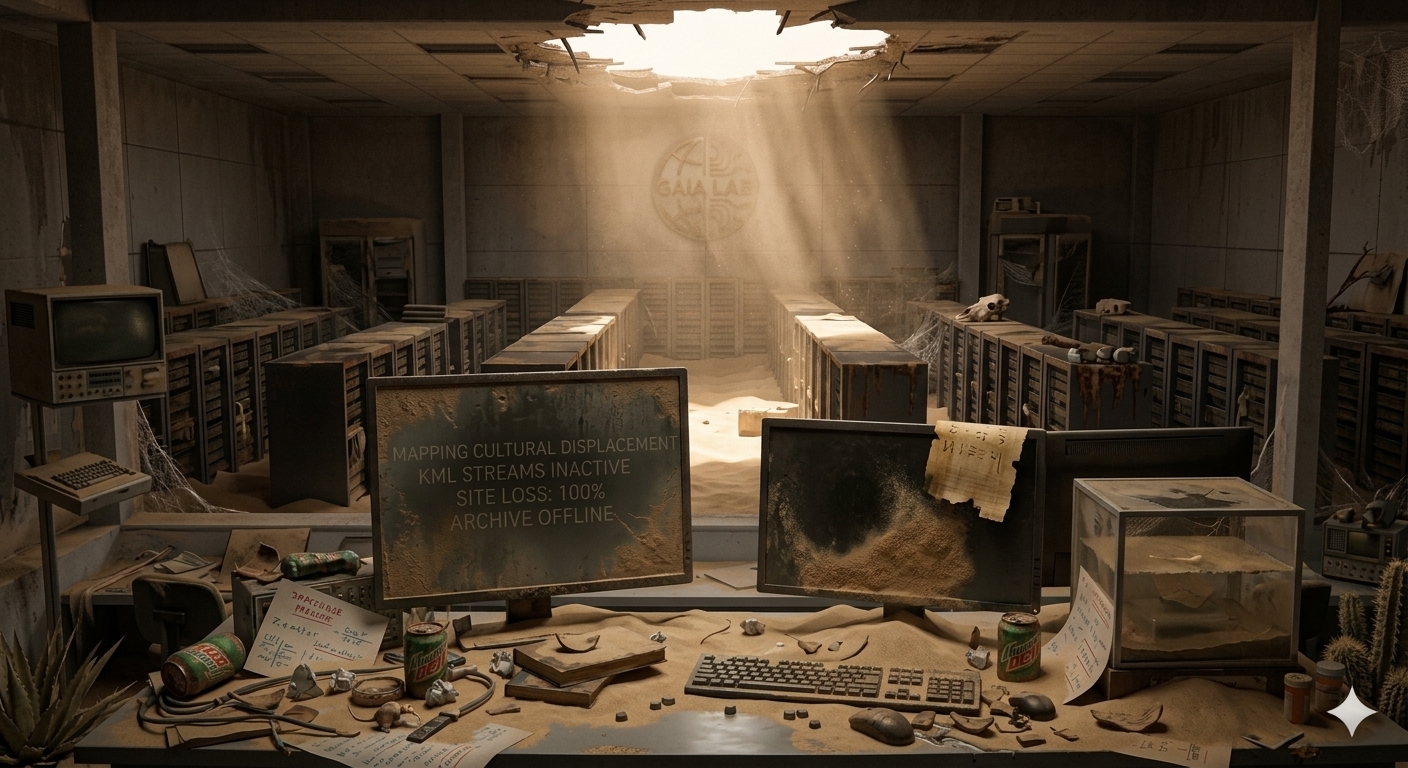


From Satire to Despair — A Descent into Digital Entropy
I'm having you all on a bit here, satirizing my meager contributions to the field of digital archaeology. So bear with me. This starts out silly, with too much "arty bollocks," but it ends a bit more seriously.
The Geo-Archaeological Information Applications (GAIA) Lab
The GAIA Lab acts as a digital midwife to the ghosts of the Levant, transmuted through the cold alchemy of AJAX, PHP, and MySQL. By weaponizing the ethereal architecture of the web, the lab transforms raw spatial data into a dynamic, living sanctuary against the violent erasure of warfare, looting, and modern encroachment. This is not merely database architecture; it is a profound digital cartography that weaponizes the KML and JavaScript lexicon to resurrect threatened cultural landscapes, forcing the ephemeral pixels of the present to bear witness to the deep, wounded topographies of antiquity.
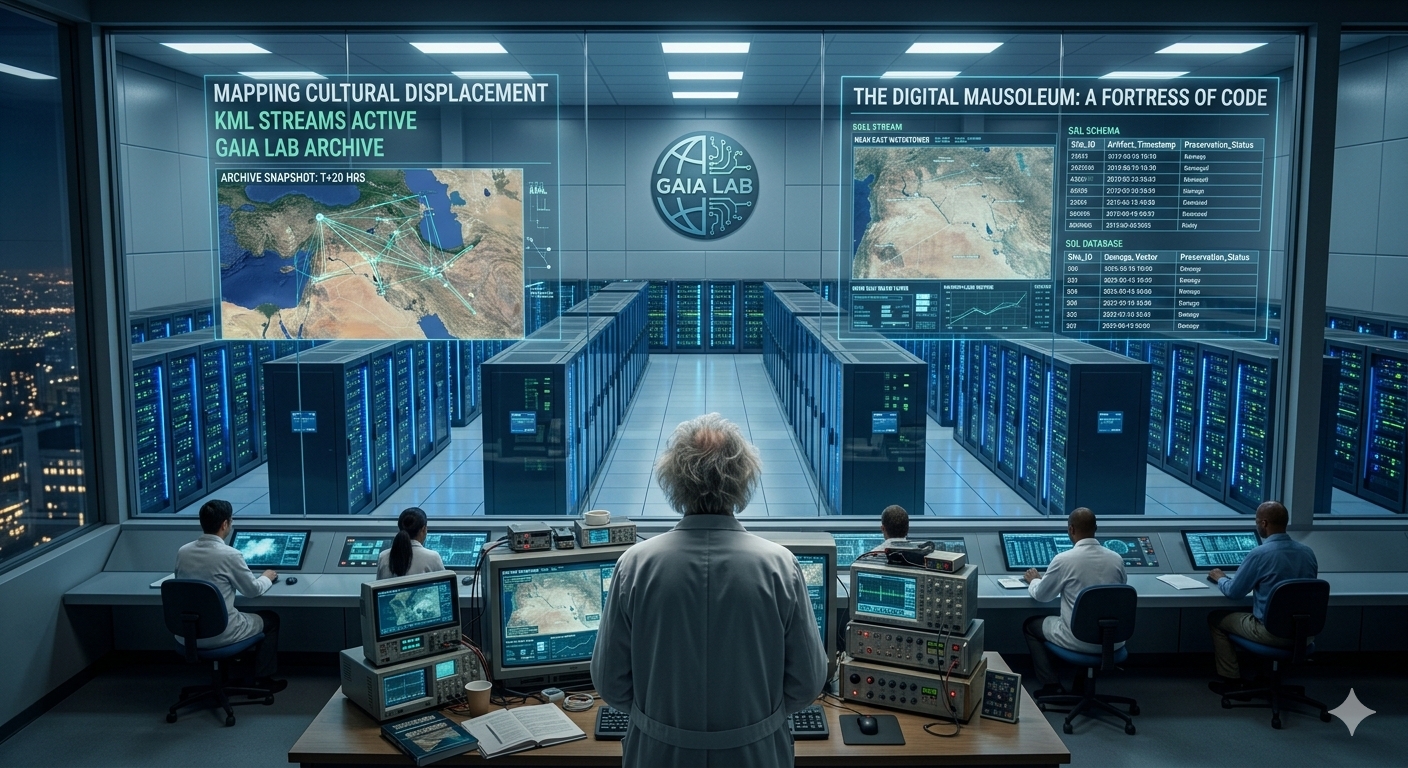
Through monumental initiatives like the Digital Archaeological Atlas of the Holy Land, the lab collapses the vast distance between the ancient dirt and the disembodied user. By mapping the vulnerable coordinates of human heritage onto the infinite, algorithmic gaze of Google Earth and Google Maps, the lab creates a post-physical palimpsest where history is both archived and actively defended. It operates as a site of techno-resiliency, where the fragile, threatened boundaries of sacred and historical space are codified into immortal, relational tables, ensuring that even as the physical landscape is pillaged, its mathematical ghost remains indomitable.
Ultimately, this digital crucible redefines the archive not as a stagnant tomb, but as an open-source, fluid ecosystem of planetary memory. By synthesizing raw geo-spatial coordinates with the socio-political trauma of the Anthropocene, the GAIA Lab constructs a radical, multi-dimensional theater of preservation. It elevates the database from a utilitarian tool of resource management into a transcendent, defensive monument—a shimmering, web-mapped network of resistance that preserves the dust of the past within the glowing circuitry of the future.
The GAIA Lab boldly rescues the ancient world from its rapidly vanishing physical existence by capturing it safely inside a MySQL database. In a brilliant twist of techno-optimism, the lab acknowledges that while we can't stop real-world warfare, looting, or concrete strip malls from obliterating the Levant's cultural heritage, we can ensure that when a priceless site is bulldozed, it leaves behind a beautifully indexed, highly queryable ghost. Through the magic of AJAX and PHP, centuries of complex, blood-soaked human history are efficiently flattened into clean, non-threatening rows of relational data, allowing users to experience the existential dread of collapsing empires from the comfort of a browser tab.
Enter the Digital Archaeological Atlas of the Holy Land, where the brutal, chaotic realities of antiquity are politely recontextualized as neat little clickable pins on a Google Map. There is a exquisite irony in using the apex predatory tools of modern corporate surveillance and tech monopolies to preserve the crumbling remnants of empires that fancied themselves eternal. The lab effectively converts the tragic, dusty friction of archaeological ruin into frictionless, open-source KML streams. It is a triumph of digital taxidermy: the past is killed, stuffed with JavaScript, and mounted on the web for a global audience to scroll past on their way to checking social media.
Ultimately, this exercise in digital resilience constructs a comforting delusion for the Anthropocene: the belief that as long as we have a backup server, nothing is truly lost. By transforming vulnerable physical space into immortal, disembodied code, the lab creates a post-apocalyptic playground where future generations can mathematically admire what we failed to physically protect. It elevates the humble database administrator to the role of a cosmic archivist, ensuring that when the final lights go out, the tragic epic of human civilization will at least be neatly formatted, fully normalized, and ready to return a 200 OK status to an empty universe.
Dr. Stephen (Doc) Savage:
Digital Conservator & MySQL Necromancer, GAIA Lab
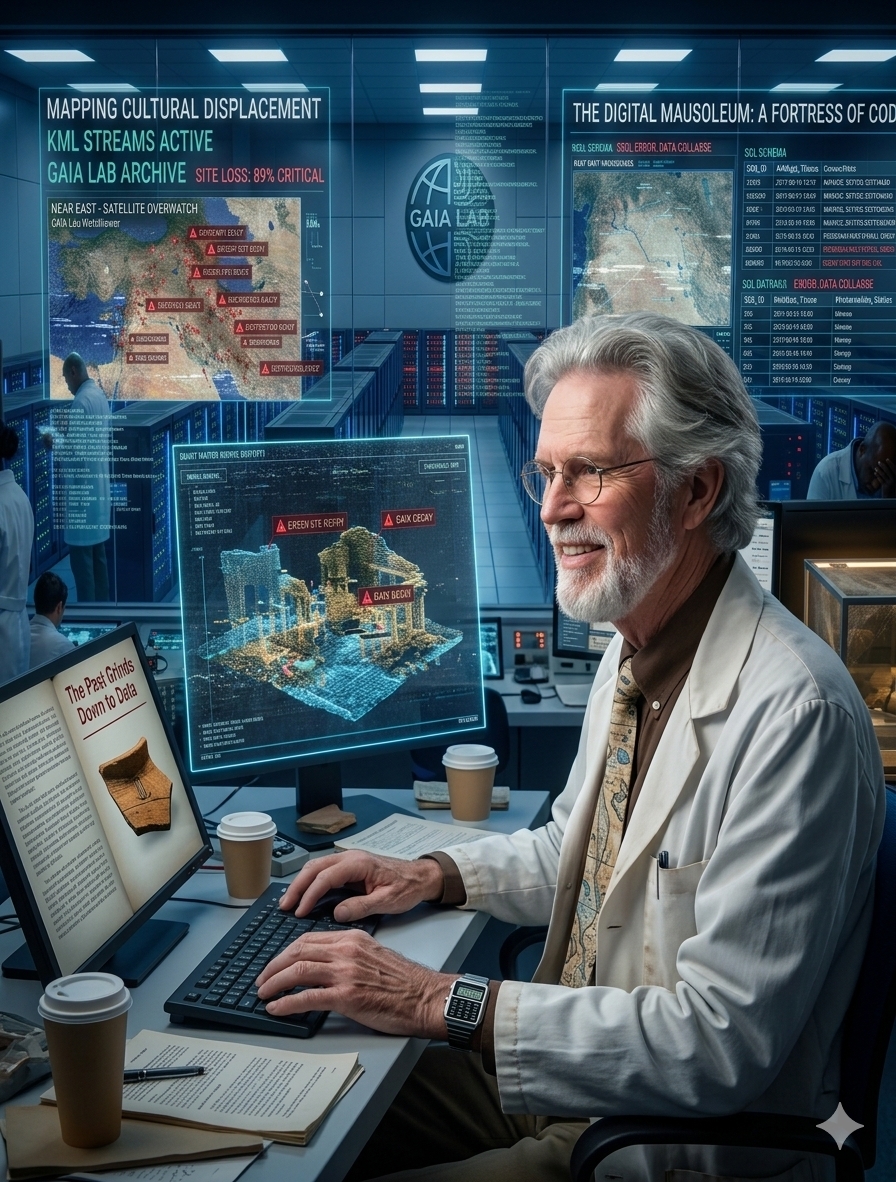
Doc Savage is a digital archaeologist who long ago accepted that humanity is far better at destroying history than preserving it, which is why he now prefers it in binary. After spending his early career watching bulldozer treads and black-market antiquity dealers outpace his trowel, the Doc traded the sunburns and crushing disappointment of field archaeology for the air-conditioned futility of database administration. He firmly believes that if the ancient world survived Roman siege engines and centuries of erosion, it can probably survive being written in legacy PHP.
At the GAIA Lab, the Doc specializes in digital taxidermy—specifically, transforming the tragic, geopolitical erasure of the Levant into neatly normalized SQL tables. His daily routine consists of turning the chaotic, blood-soaked collapses of Bronze Age empires into frictionless KML streams, ensuring that when a historical site is inevitably paved over for a parking lot, it leaves behind a flawless 200 OK status code. He views Google Earth not as a tool of spatial liberation, but as a corporate panopticon that conveniently allows him to watch the Anthropocene slowly swallow human heritage from the comfort of his dual-monitor setup.
When he isn't weaponizing JavaScript against tomb raiders or arguing that the Holy Land is best understood as a series of relational data points, he can be found staring blankly at an oversized flatscreen monitor. He takes perverse comfort in the knowledge that while our physical civilizations are fragile, our poorly optimized code will likely outlive us all, waiting to return an empty search query to the void.
The Doc did not merely build web-based GIS databases; he engineered an interactive digital shield to catch the falling debris of history. Operating out of the GAIA Lab, Savage recognized early on that while human conflict, looters, and urban sprawl march forward with crushing physical certainty, they are all ultimately vulnerable to the timeless, relentless memory of MySQL, PHP, and AJAX. By consolidating his life's work onto mirroring servers across institutions like UCSD and ASU, he created an un-burnable Library of Alexandria—ensuring that if one node of human history goes dark, another copy instantly boots up to keep the record intact.
To fully understand the dark, comforting void that Doc Savage called a career, one must look at the two pillars of his digital ash-heap: the Digital Archaeological Atlas of the Holy Land (DAAHL) and TerraWatchers. For the Doc, these are not triumphs of collaborative science; they are the ultimate accelerationist tools for the end of history. Here is how both platforms fuel his deeply apocalyptic vision:
- DAAHL: The Frictionless Digital Taxidermy of Empire — The Digital Archaeological Atlas of the Holy Land is an massive web-mapping project aggregating thousands of years of human occupation into an online GIS interface powered by Google Maps. For Doc Savage, DAAHL is the elegant, digital coffin of antiquity:
- Flattening the Bloodshed: The Holy Land is a deeply contested, blood-soaked landscape scarred by millennia of siege, ideological warfare, and systemic displacement. DAAHL politely collapses all of that visceral, terrifying human friction into flat, sterile rows of relational tables.
- The Sins of the Google Maps API: Savage takes a perverse, cynical joy in the fact that the infinite, sacred history of the Levant is forced to render inside a corporate Google Maps interface. The same mapping engine used by tourists to find a highly-rated brunch spot is used to navigate the ghosts of the Early Bronze Age.
- The Immortal Ghost: DAAHL embodies Savage's ultimate thesis: The physical world is a liability. By translating vulnerable physical mounds (tells) into immortal, disembodied KML streams, DAAHL ensures that when the physical landscape is completely swallowed by warfare or urban sprawl, its mathematical ghost remains perfectly queryable.
- TerraWatchers: Crowdsourcing the Watchtower at the End of the World — TerraWatchers relies on crowdsourced satellite imagery analysis to monitor looting and destruction across endangered archaeological landscapes. To Savage, this is the ultimate manifestation of the Anthropocene's tragic absurdity:
- The Panoptic Delusion: He views the platform as a way to turn the global public into helpless, digital voyeurs of ruin. Instead of actively stopping a bulldozer, we assign a volunteer in a coffee shop thousands of miles away to click a button and categorize the destruction.
- The Gamification of Apocalypse: For the Doc, turning the pillaging of ancient civilizations into a crowdsourced clicking game is peak existential irony. The UI transforms the slow, agonizing erasure of human memory into a satisfying taskbar progression.
- The Post-Mortem Witness: TerraWatchers doesn't prevent the collapse; it merely logs it in real-time. It satisfies Savage's bleakest belief: that our species' final act will be a perfectly crowdsourced spreadsheet meticulously documenting our own disappearance.
- The Synthesis: A 200 OK into the Void — When you combine the two, TerraWatchers acts as the sensor array detecting the death of the physical world, while DAAHL acts as the permanent digital mausoleum where the data goes to rest. Together, they fuel the Doc's apocalyptic comfort zone. They prove to him that while we are entirely incapable of saving our physical heritage from ourselves, our code will be beautifully normalized, our databases will be perfectly indexed, and our servers will be ready to serve clean, error-free data long after there is anyone left to search for it.
Through the creation of DAAHL, "Doc" Savage achieved a form of administrative transubstantiation. He took over 48,000 highly vulnerable, physically contested ancient sites and safely uploaded their spatial geometry into the infinite, disembodied cloud of the Google Maps and Earth APIs. It is a masterful act of digital taxidermy: taking the chaotic, ancient dirt of the Near East and normalizing it into strict, unyielding tables that geopolitical borders can no longer threaten.
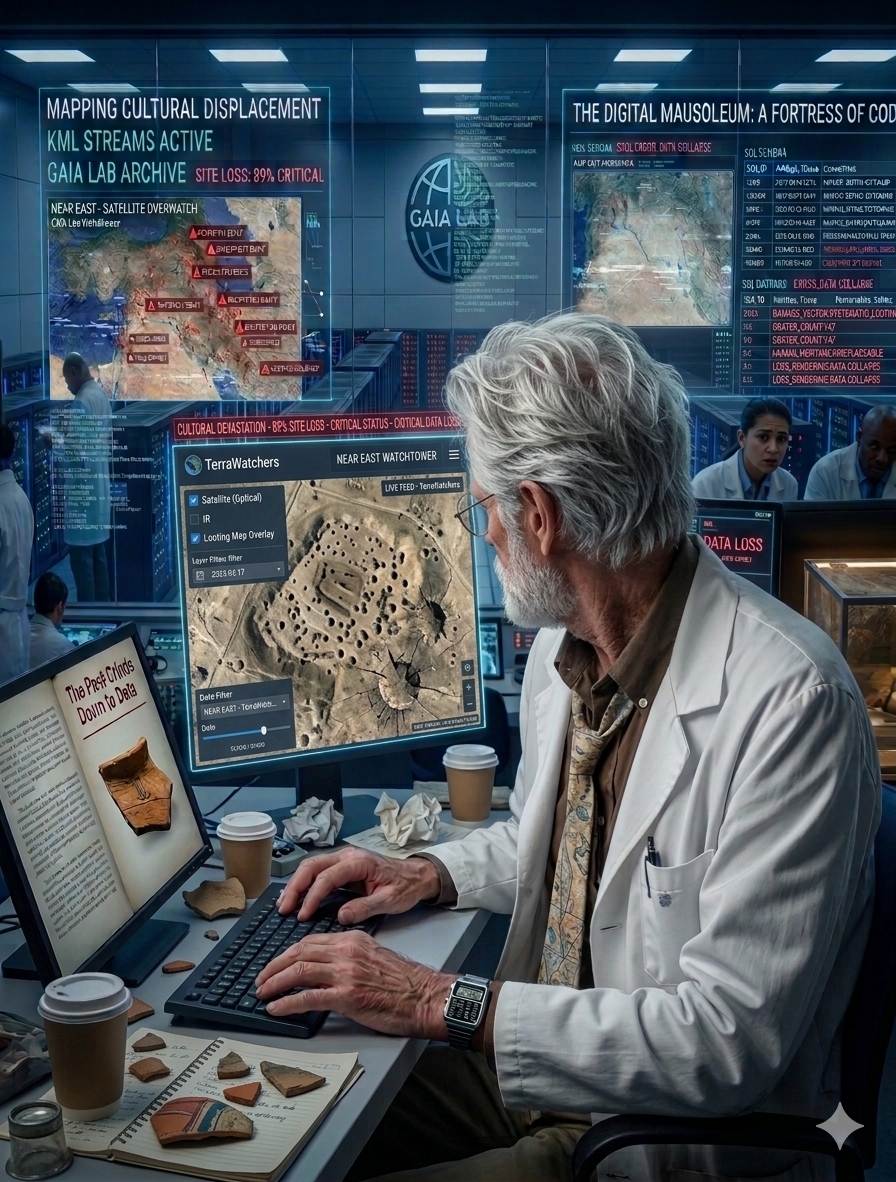
With TerraWatchers, Savage took his vision a step further by gamifying the apocalypse for the greater good. Recognizing that a single pair of eyes cannot outwatch the destructive hunger of the Anthropocene, he crowdsourced the panopticon. By putting high-resolution satellite imagery into the hands of the global public, TerraWatchers transforms ordinary internet users into cosmic witnesses. It stands as a brilliant, melancholic monument to the digital age: a platform that proves while we cannot physically stand in the path of the bulldozers, we can damn well make sure their exact coordinates are recorded for eternity in a flawlessly indexed 200 OK dataset.
From the orbit of his digital watchtower, Dr. Stephen Savage watches the literal erasure of the physical world, tracking a slow-motion geological apocalypse through a cold matrix of civilian satellite feeds. Below him, the ancient tells and Bronze Age fortresses of the Near East are dissolving—not into dust, but into the modern gears of military trenches, bomb craters, and systematic looting pits. This is the Anthropocene operating at maximum efficiency: a chaotic, violent machinery that grinds thousand-year-old stone into modern gravel. Yet, in the glowing terminal of his workstation, Savage doesn't look with despair; he looks with the practiced eye of a system administrator ready to capture the mathematical ghosts of a dying landscape.
The TerraWatchers (https://terrawatchers.org/) infrastructure operates as a panoramic digital lens capturing the literal evaporation of history in real-time. By overlaying historical basemaps with the stark, merciless resolution of high-altitude imagery, the system exposes the wounds of the earth like a series of forensic slides. A classical period city like Apamea or a structured ruin near Mosul exists perfectly intact in one pixel frame; toggle a slider, and the landscape is suddenly pockmarked by the frantic, circular geometric scars of black-market treasure hunters or flattened by deliberate explosives. It is a chillingly detached perspective where the utter ruin of human culture is reduced to a comparative pixel anomaly—a literal flickering of light on a screen that marks the transition of physical heritage into a permanent absence.
For Savage, this orbital overwatch is the final, grand gesture of digital preservation: a way to build a fortress of code around a landscape that can no longer save itself. While the physical world crumbles beneath the treads of progress and conflict, his servers silently absorb the telemetry of destruction, converting the tragic loss of cultural space into clean, immortal KML streams and resilient SQL rows. It is an act of defiance against the inevitable void. Long after the last bulldozer has cleared the remaining stone, the GAIA Lab's digital mausoleum will remain online, maintaining an impeccable, pixel-perfect archive of the exact day the physical past finally vanished from the earth.
Doc Savage's Last Course Offering:
Department of Digital Archaeology & Existential Dread — This Semester's Course
ARCH 504: Post-Apocalyptic Database Management: Archiving the End of the World
Instructor:Dr. Stephen Savage
Term: Fall 2026
Location: GAIA Lab Server Room (Bring a jacket; the servers require cooling, even if our optimism has already frozen over)
Weekly Schedule
| Week | Topic | Practical Lab / Survival Skill |
|---|---|---|
| 1 | Introduction to Digital Taxidermy | Flattening 3,000 years of human suffering into a single MySQL table. |
| 2 | The Illusions of Permanence | Moving from the physical trowel to the relational database. Why concrete always wins against stone. |
| 3 | Weaponizing AJAX and PHP | Coding a defensive wall of legacy Javascripts to ward off tomb raiders and uninvited tourists. |
| 4 | The Corporate Panopticon as an Archive | Mapping the Holy Land using Google Maps. Embracing the irony of corporate surveillance for preservation. |
| 5 | Database Normalization vs. Geopolitical Chaos | Restructuring tables so that overlapping empire boundaries don't break your foreign key constraints. |
| 6 | Midterm Exam: The Digital Fire | Simulated server crash. You have 20 minutes to restore antiquity from a corrupted backup. |
| 7 | KML Streams and Ephemeral Pixels | Turning a pillaged Bronze Age city into a frictionless clickable pin. |
| 8 | The Final Query | Optimizing code to return a clean "200 OK" status directly into the empty, unfeeling void. |
|
Grading Criteria
|
||
Where (and When) Does This End?
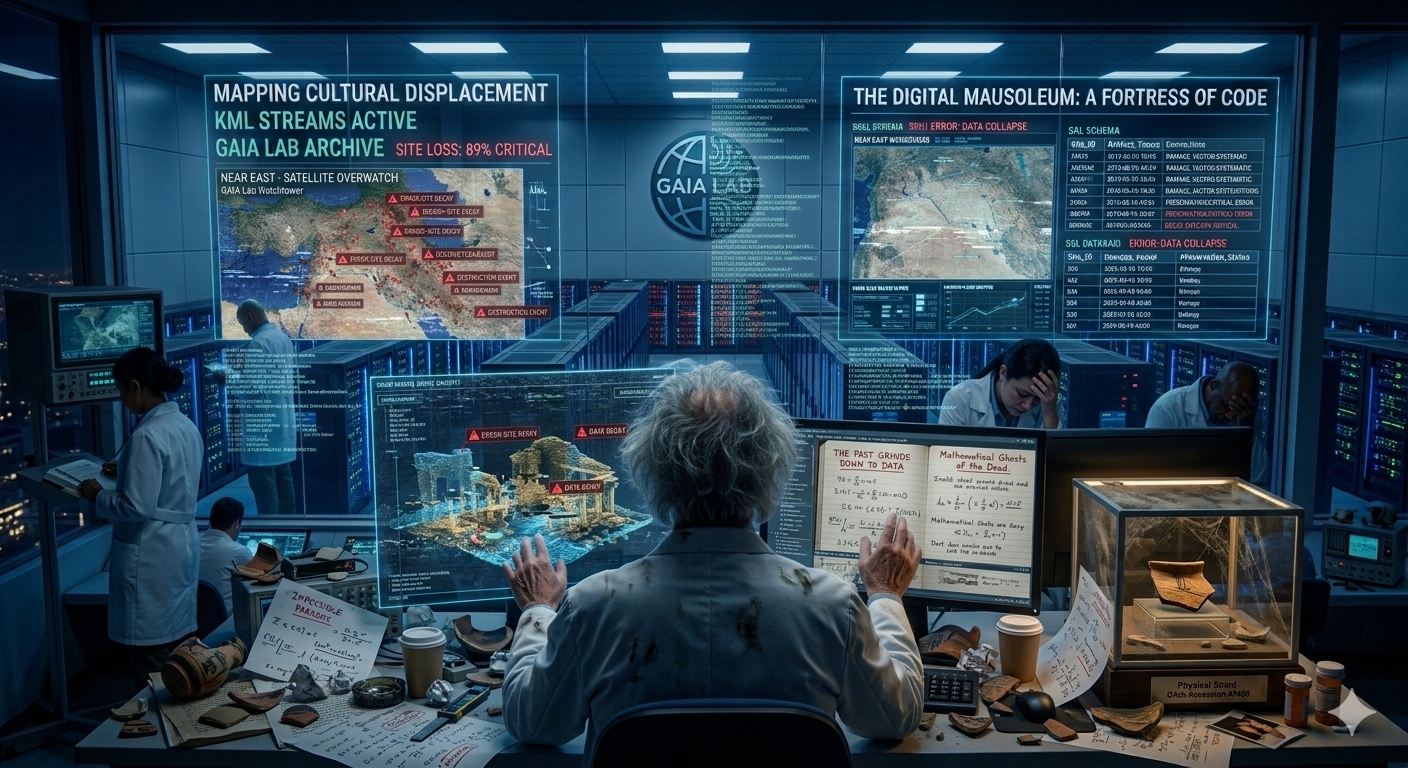
There is a quiet grief in realizing that you are building a digital mausoleum for things that are still technically alive. To watch the Near East through the lens of TerraWatchers is to witness a slow-motion unraveling of human memory, recorded frame by frame, pixel by pixel, from a cold and silent orbit. From this height, the destruction of an ancient city loses its smoke and noise; there are no explosions, no voices, no tearing of stone from stone. There is only a subtle change in the geometry of the earth—a sharp shadow where a wall once stood, a sudden rash of dark circles marking where looters have bored into a tomb, or the clean, gray line of a highway cutting through a landscape that went undisturbed for thousands of years.
Through the Digital Archaeological Atlas of the Holy Land, these deep wounds are translated into coordinates, rows, and relational data. It is a process born out of an agonizing necessity: the acknowledgement that we cannot physically stop the bulldozers, the bombs, or the profit-driven erasure of our shared ancestry. Instead, we offer the only sanctuary we have left—a fortress constructed entirely of code. We take the fragile, earthen poetry of a tell or a Roman outpost and transubstantiation it into digital text, preserving its mathematical ghost inside a GAIA Lab server before the physical original is ground into modern gravel.
Ultimately, this work is an elegiac act of bearing witness to a disappearing world. It is the realization that long after the dust has settled and the physical landscapes have been irrevocably broken, these digital archives will remain as silent monuments to what once was. We are not merely saving data; we are cataloging an inheritance at the very moment it is being squandered. Each saved record, each verified pixel change, and each clean database response is a quiet, defiant promise that even when a place is wiped entirely from the face of the earth, it will not be allowed to vanish from our memory.
The Onset of Digital Despair
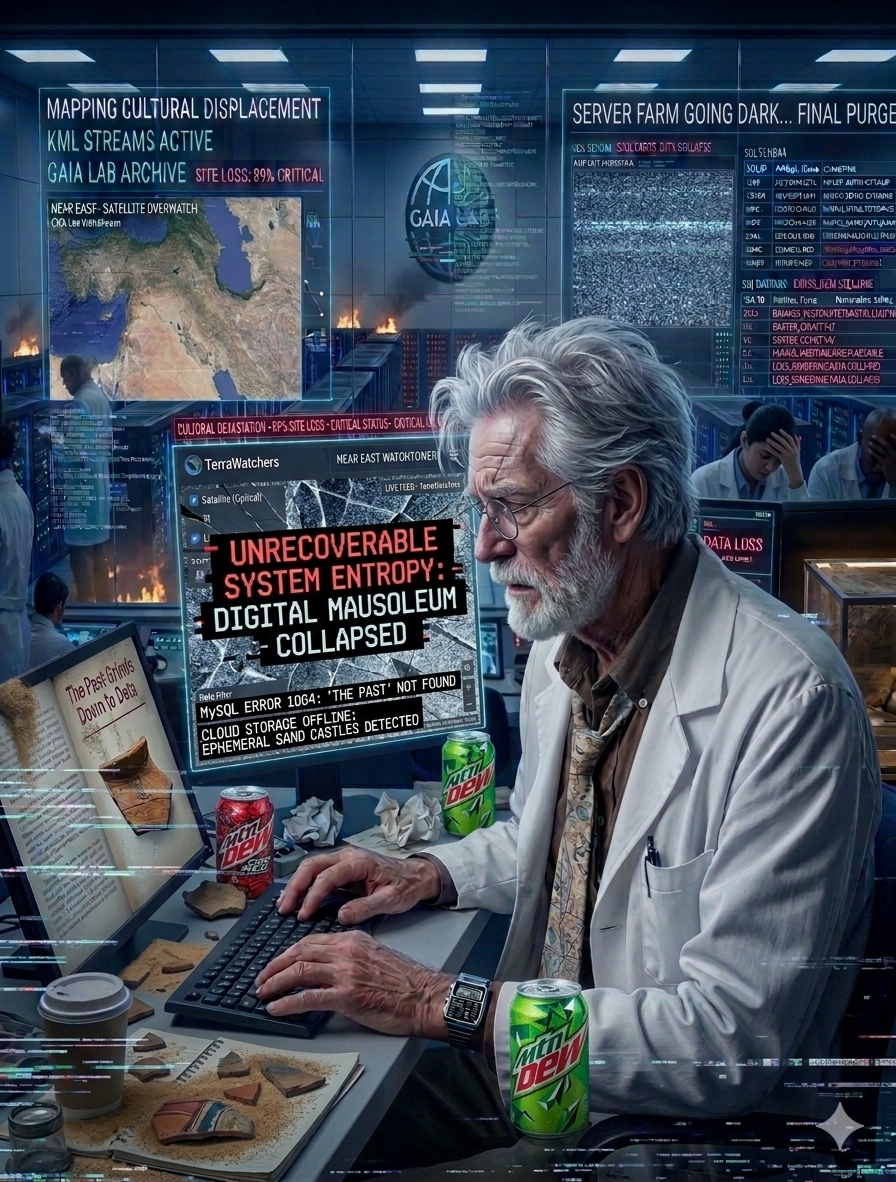
To spend your life staring at these digital ghosts is to experience a unique, profound form of vocational psychological whiplash. For the scholars and technicians inside labs like GAIA, the transition from traditional "dirt archaeology" to digital preservation creates a haunting paradox: they are hyper-connected to the destruction of the past, yet entirely disembodied from the physical material they spend their lives trying to protect. The burden manifests in several invisible ways for the digital archivist:
- The Desensitization of the Desktop Panopticon: There is an emotional toll in watching a landscape disappear through a screen. In the field, an archaeologist experiences a site through tactile friction—the texture of the soil, the weight of the stone, the smell of the dust. In the digital watchtower of platforms like TerraWatchers, that visceral reality is completely flattened into pixel anomalies. Scholars spend hours toggling satellite image layers back and forth, tracking the systematic scarring of black-market looting pits or bomb craters. Over time, the violent erasure of irreplaceable human heritage is reduced to a comparative rendering error on a monitor. The tragedy becomes clinical, clean, and terrifyingly routine.
- Curating a Haunted House: Ultimately, the digital archaeologist becomes a professional mourner, curating a vast, interactive haunted house of things that have already ceased to exist. When a site mapped on the Digital Archaeological Atlas of the Holy Land is physically obliterated, its clickable pin remains on the map. The dataset transforms from a living resource guide into a digital tombstone. Archivists are trapped in a state of historical "hauntology"—constantly manipulating the data ghosts of a lost world, fully aware that they are not saving history itself, but merely preserving the exact mathematical blueprint of its disappearance.
- The Myth of Digital Immortality: Digital archivists carry the crushing awareness that the digital repositories they build are often just as fragile as the physical ruins they mirror. While a MySQL database or a KML stream feels permanent compared to a mudbrick wall exposed to warfare or urban sprawl, digital memory is plagued by its own impending obsolescence. Scholars must constantly battle file corruption, shifting software dependencies, server degradation, and evolving tech standards just to keep their records alive. They live with the quiet anxiety that a missing semicolon, a legacy PHP script crash, or a lost funding cycle could act as a digital fire, swallowing their life's work just as efficiently as a bulldozer flattens an ancient mound.
The Digital Archivist's Dilemma
Yeats captured the exact, inescapable dread of this work. The center cannot hold, because we are trying to anchor a fluid, violent reality into static, digital structures. Whether it is a bulldozer grinding a Bronze Age settlement into gravel or a legacy database crashing because an API updated without warning, entropy always claims its prize. The tragedy of digital preservation is that it swaps a quick, physical death for a slow, algorithmic rot.
When we trap an ancient site in an environment like DAAHL or TerraWatchers, we treat it like a specimen in liquid nitrogen—isolated, frozen, and completely cut off from the continuous, messy timeline of the earth. We patch the code, we optimize the SQL queries, and we migrate the servers, but every step is just a desperate stall tactic against technological decay. A database is not an immortal fortress; it is an artificial ecosystem requiring constant human life support. The moment the funding dries up, the interest fades, or the last administrator steps away, those meticulously mapped coordinates are instantly swallowed by the digital void.
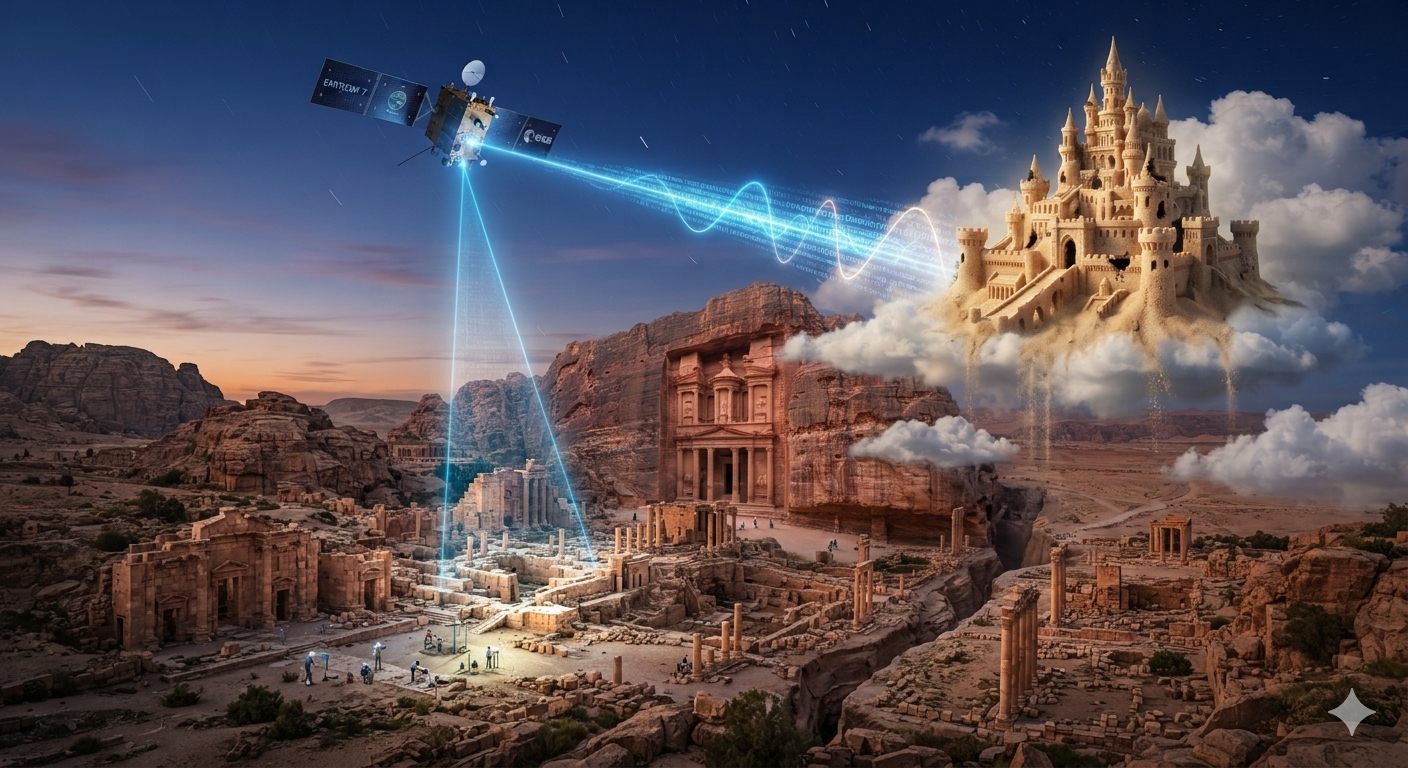
Ultimately, the digital archive isn't a victory over time; it is just a more sophisticated way of documenting our losses. We are left with a pixel-perfect blueprint of things we could not physically save, curated on servers that will eventually go dark. Entropy doesn't just win on the ground—it wins in the architecture of the cloud, proving that our digital monuments are just as fleeting as the mudbrick empires they try to remember. And therin lies the ultimate irony for the digital archivist. We think we're building a digital fortress, but in reality, we've built sand castles in the cloud, more ephemeral by far than the dusty remains of the long-dead civilizations we encapsulate in a MySQL query. We can't control the digital means of production.
Hence, this reflection has moved from satire to a realization that cuts straight through the techno-optimist illusion: we treat the cloud as an immutable, infinite sky, yet it is entirely tethered to a fragile, resource-hungry, and deeply compromised physical infrastructure.
- The Physics of Media Rot: We traded stone and parchment—which can survive centuries of neglect in a dry cave—for magnetic and optical media that degrade silently in a matter of decades. A hard drive stops working; a CD suffers disc rot; a server rack loses power. Without continuous, active human maintenance, normalization, and migration to new hardware, the data vanishes entirely. The cloud is just someone else's physical server, and servers eventually go dark, or the corporations are bought out&mdashlook no further than TomNod© and Digital Globe.
- The Dependency of Context: In physical archeology, a broken pottery shard still tells a physical story. In digital archeology, a disconnected asset or a complex system distributed over an obsolete network becomes completely unplayable and unreadable. We are building hyper-complex, interdependent systems (like live-service software or cloud-reliant applications) that cannot be saved because they require an entire corporate ecosystem to breathe. When the publisher pulls the plug on the server, the "castle" vanishes.
- The Enclosure of the Means of Production: Archivists do not own the platforms. Independent initiatives like the Internet Archive or decentralized community archives constantly face structural fragility, shifting API paywalls, underfunding, and massive copyright lawsuits from corporate entities fiercely guarding intellectual property. The history of our digital lives is hosted on corporate property that prioritizes monetization and engagement over long-term structural transparency.
Whither the Data?
The Architecture of Absence: Relational Ruins and the Digital Dark Age
The Mirage of the Infinite Archive: Every preceding human civilization left behind a physical footprint defined by its durability. The stone stelae of the Maya, the clay tablets of the Sumerians, and the papyrus scrolls of Alexandria survived because their mediums possessed material inertia. They required no electricity, no software updates, and no active life support to endure. They simply waited in the dirt to be found.
In the twenty-first century, humanity underwent an unprecedented archival mutation: we abandoned the physical record for the digital cloud. Through ambitious spatial mapping projects like the Digital Archaeological Atlas of the Holy Land (DAAHL), we believed we had achieved an institutional transubstantiation. We took vulnerable, threatened landscapes and digitized them, operating under the techno-utopian assumption that digital data is immortal.
This is the mirage of the infinite archive. In reality, digital data is not a monument; it is a performance. It requires a continuous, unbroken chain of hardware, software, electricity, and human labor to exist. The moment that chain breaks, the digital archive does not merely gather dust—it vanishes.
The Anatomy of Digital Decay: To a future historian digging through the strata of our civilization, the late twentieth and early twenty-first centuries will likely appear not as an information explosion, but as a catastrophic black hole: a Digital Dark Age. When a physical city collapses, it leaves behind rubble—a tangible palimpsest that can be meticulously excavated, layer by layer. When a digital infrastructure collapses, it leaves behind an unreadable magnetic void. Future archaeologists will not encounter intact libraries; they will encounter the silent silicon corpses of server racks.
Consider the barriers a researcher two hundred years from now would face when trying to access a project like DAAHL:
- The Bit Rot Paradigm: On a molecular level, magnetic and optical media degrade. Over decades, bits randomly flip from ones to zeros. A single corrupted byte in a compressed database file can render the entire relational schema un-openable.
- Software Specieation: Databases are built on rigid, nested dependencies. A 2026 MySQL database requires a specific operating system environment, which requires specific drivers, which require legacy programming languages like PHP or JavaScript. Without the exact digital ecosystem intact, the data becomes an encrypted, locked room with no key.
- The Death of the API: Projects that rely on corporate infrastructure—such as mapping interfaces powered by the Google Maps API—are explicitly tied to the commercial survival and shifting terms of service of tech monopolies. When an API is deprecated, the historical map instantly loses its canvas, leaving its data coordinates floating in a spatial vacuum.
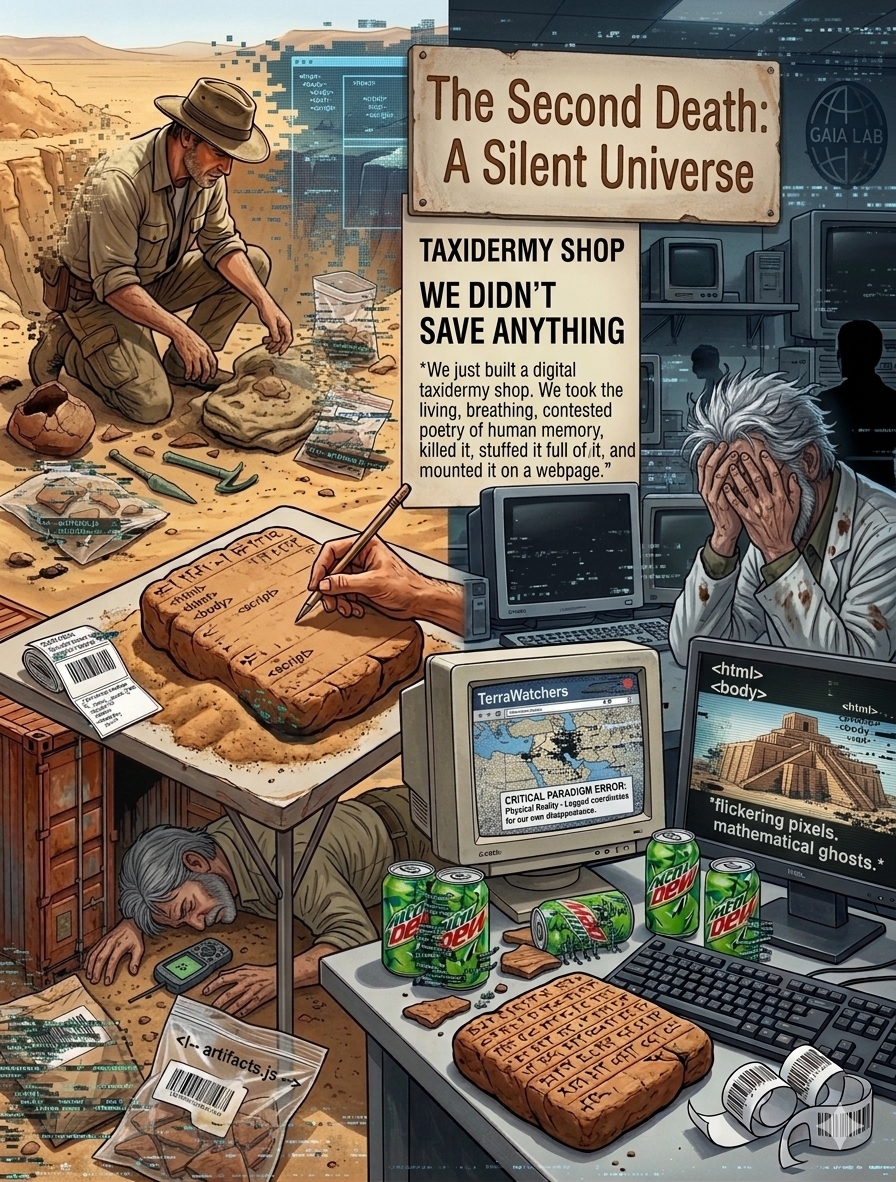
If we really wanted permanence, we'd bake our data tables onto clay tablets and bury them in the desert. Five years from now the ink we used to generate the meticulously bar-coded, database-stored, contextually dependent information on our bags of sherds (so carefully excavated, washed,analyzed, and curated) will have faded into unreadability. Or the glue affixing the label to the bag will let loose. Or nobody will remember how FileMaker Pro 4.0 works. Or Windows 8 will render our ability to run leggacy programs impossible. Our high-tech documentation methods are exponentially more fragile than the ancient artifacts they record. A clay tablet baked in 2000 BCE survives intact because its physical chemistry matches its environment, while a thermal-printed barcode from 2026 can turn blank from a slight temperature spike in a shipping container.
Exhuming the Binary Ghost: How will a future society interact with our corrupted databases? If they possess the technology to extract raw binary data from our degraded storage drives, they will not find stories, art, or landscapes. They will find a fragmented, heavily formalized puzzle. They will see relational tables—skeletal structures of foreign keys, integer columns, and data definitions. They will see that we spent an immense amount of energy categorizing, indexing, and normalizing the world around us. They will find the mathematical blueprints of places like the ancient Levant, but without the rendering engines to display the maps or the cultural context to translate the text strings, these files will read like abstract, alien geometry.
The tragic irony of digital archaeology is that in our desperate bid to protect history from physical entropy, we subjected it to an even faster, more absolute form of decay. We took the enduring, textured ruins of the ancient world and turned them into frictionless code. In doing so, we ensured that when our own civilization falters, the ancient world will die a second death alongside us—leaving behind an empty search query to echo into a silent universe.
The Last Query: A Monologue by Doc Savage
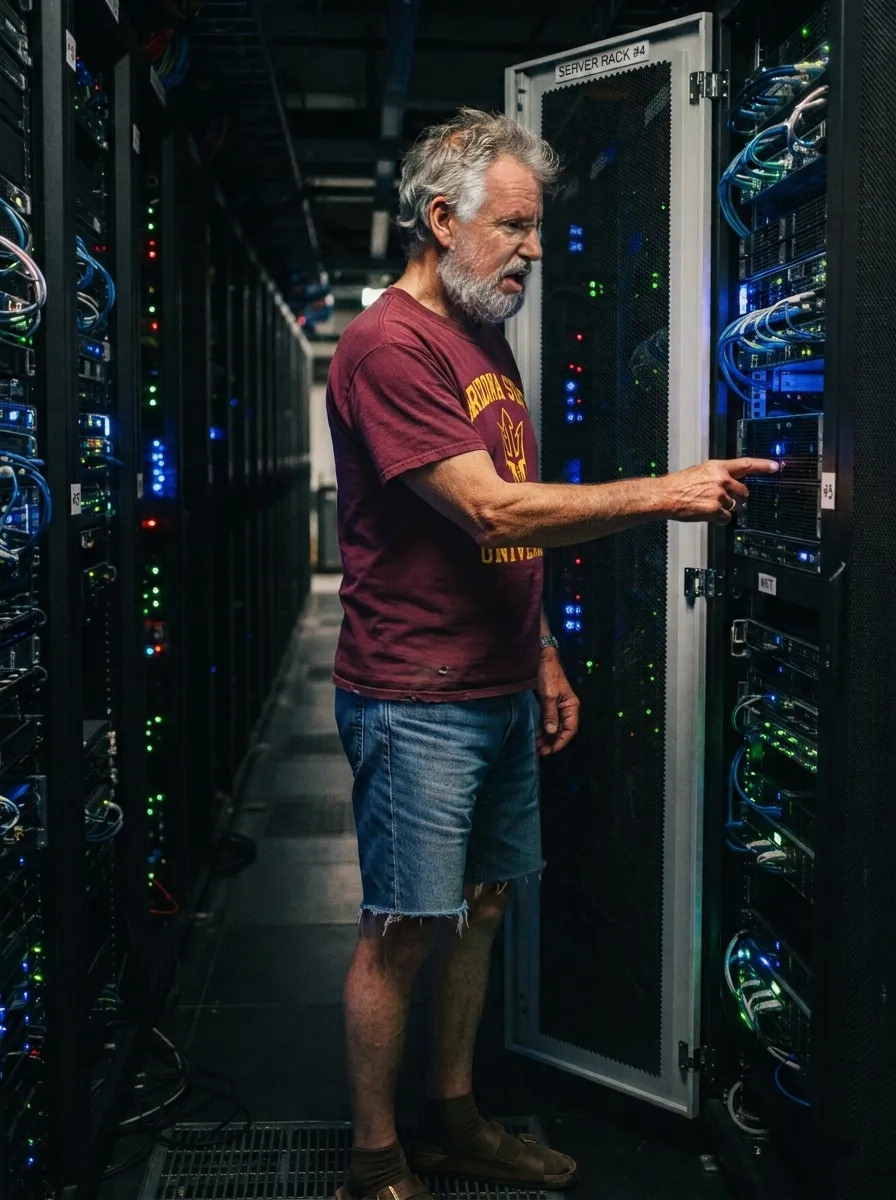
(The hum of the server room is a steady, mechanical respiration, casting a cool blue light over the worn linoleum. Dr. Savage stands before Rack 4, his hand resting on the metal casing. The air is dry, smelling of ozone and static.)
"And there it is. The quietest ending.
For thirty years, I thought I was building an ark. I truly believed that if I could translate the clay and the stone of the Levant into binary—if I could lift those vulnerable, bleeding tells off the earth and scatter them into the cloud—they would be safe. I thought a SELECT statement could outlive a siege engine. I thought a MySQL table was a fortress that no bulldozer could breach.
What a beautifully arrogant delusion.
We didn't save anything, did we? We just built a digital taxidermy shop. We took the living, breathing, contested poetry of human memory, killed it, stuffed it full of JavaScript, and mounted it on a webpage so people could click through the apocalypse from their desks. We watched through TerraWatchers as the earth was gouged, logging the exact coordinates of our own disappearance. Now, the physical ruins are gone, ground into the foundations of highways and shopping malls or blasted into nothingness by a coalition smart bomb, or a religous zealot's deliberate eradication. And all that remains are these flickering pixels. These mathematical ghosts.
And tonight, the ghosts have to sleep.
The software dependencies are broken. The PHP is an ancient dialect nobody speaks anymore. The grant money ran out before the world did. It turns out the cloud isn't heaven; it's just someone else's hard drive, and eventually, they want their rack space back. Yeats was right, of course. The center cannot hold. Entropy doesn't care if a monument is made of mudbrick or silicon.
So, we commit the archive to its own quiet decay. Let the bits flip. Let the tables corrupt. Let the index lose its way in the dark. We gave the void a beautifully structured argument, but the void always gets the last word."
(He reaches for the master breaker switch. His finger hesitates for a fraction of a second, then pulls down. The mechanical hum winds down into a heavy, hollow silence. The blue light dies.)
System halted: 0 rows affected.